Let’s be honest: "Web Directory" sounds like a relic from 1999. It conjures images of clunky, ugly lists of links that serve no purpose other than to clutter the internet.
But if you are ignoring directories in 2026, you are leaving one of the most foundational SEO levers untouched.
Here is the reality: Google’s algorithm has evolved, but it hasn’t abandoned the basics. It still needs to verify that you are who you say you are.
High-quality, free web directories don't just provide backlinks; they provide citations—digital fingerprints that prove your business's legitimacy, location, and relevance.
For startup founders and tech enthusiasts, this isn't about spamming 1,000 low-quality sites. It is about strategic placement on high-authority domains that drive referral traffic and signal trust to search engines.
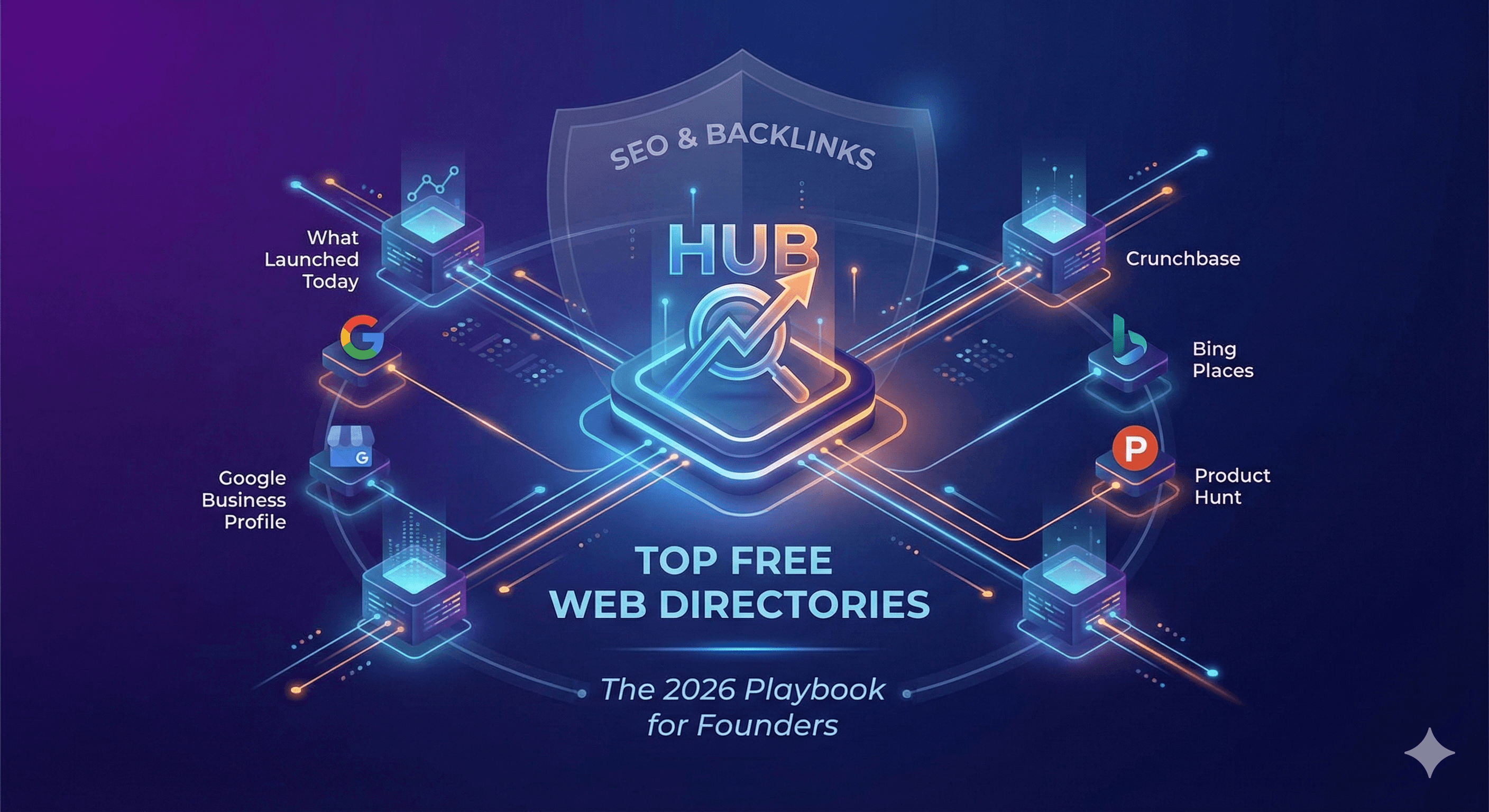
This guide synthesizes the best data available to give you a prioritized, actionable list of free web directories that actually move the needle.
The Strategic "Why": It’s Not Just About the Link
Before we dive into the list, we need to dismantle a common myth. A directory link often carries a "NoFollow" tag, meaning it doesn't always pass direct "link juice" (PageRank) to your site. So, why bother?
1. The Trust Signal (E-E-A-T)
Google’s E-E-A-T (Experience, Expertise, Authoritativeness, Trustworthiness) framework is the gatekeeper of rankings. When an established platform like Bing or What Launched Today lists your URL, it acts as a third-party verification. It tells Google, "This entity exists, and we vouch for it."
2. Diversifying Your Link Profile
If 100% of your backlinks come from high-cost guest posts, it looks suspicious. A natural backlink profile includes a healthy mix of editorial links, social links, and directory citations. Directories provide the "bedrock" links that make your profile look organic and safe.
3. Referral Traffic & Intent
Users on directories are usually in "hunt mode." They aren't browsing for entertainment; they are looking for specific tools, agencies, or services. A presence on these platforms puts you directly in the path of high-intent traffic.
Tier 1: The "Must-Haves" (General Authority)
These are the non-negotiables. These platforms have massive Domain Authority (DA) and are the first places search engines look to verify your NAP (Name, Address, Phone) data.
1. Google Business Profile (formerly GMB)
- The Powerhouse: This is arguably the most critical listing for any business, local or digital. It feeds Google Maps and the "Local Pack" in search results.
- Actionable Tip: Don't just fill in the basics. Utilize the "Updates" feature to post weekly about new product features or blog posts. This signals to Google that the business is active.
- Cost: Free.
2. Bing Places for Business
- The Resurgence: With Microsoft’s integration of AI into Bing, usage has spiked. Neglecting Bing means ignoring a significant chunk of the desktop search market.
- Actionable Tip: You can sync your Google Business Profile directly to Bing Places, saving you the setup time.
- Cost: Free.
3. Yelp
- The Social Proof Engine: While often associated with restaurants, Yelp ranks incredibly well for B2B services and tech agencies. Apple Maps often pulls data from Yelp, meaning a listing here gets you into the iPhone ecosystem.
- Actionable Tip: Respond to every review. Responsiveness is a publicly visible metric that builds trust with potential leads.
- Cost: Free (with paid upgrade options).
4. LinkedIn Company Directory
- The B2B Standard: You likely have a personal profile, but a dedicated Company Page is essential for schema markup and brand entity establishment.
- Actionable Tip: Ensure your "About" section is keyword-rich and links back to your core landing pages.
- Cost: Free.
Tier 2: The Tech & Startup Stack
For the audience reading this—founders, devs, and product managers—generic directories aren't enough. You need niche relevance. These platforms cater to early adopters and tech scouts.
5. What Launched Today
- The Launchpad: This platform is rapidly becoming a go-to for discovering new SaaS tools, AI wrappers, and dev utilities.
- Why It Works for SEO: What Launched Today offers a fresh, dynamic backlink from a domain relevant to the tech industry. Unlike stagnant directories, the content here is driven by "newness," which Google loves.
- Strategic Play: Submit your tool the day you push a major update. The audience here loves "new," so frame your listing around your latest feature or pivot.
- Cost: Free submission options available.
6. Product Hunt
- The Viral Engine: While technically a launch platform, a Product Hunt page is permanent. It serves as a high-authority directory listing that often outranks a startup's own website for branded searches.
- Strategic Play: Invest time in your visuals. The thumbnail and first comment (from the maker) are the highest leverage points for conversion.
- Cost: Free.
7. Crunchbase
- The Investor’s Database: If you want to be taken seriously by VCs or enterprise partners, you need a Crunchbase profile. It is the Wikipedia of the startup world.
- Why It Matters: Crunchbase feeds data to countless other aggregators. One listing here often spawns ten others automatically.
- Cost: Free (basic profile).
Tier 3: The High-Volume Generalists
These sites have high traffic and decent authority. They are excellent for broadening your digital footprint.
8. YellowPages (YP.com)
- The Classic: Despite its age, YP.com holds massive domain authority. It’s excellent for local SEO.
- Cost: Free.
9. Chamber of Commerce
- The Credibility Booster: Listing here signals that you are a verified, operational business entity. It is a strong trust signal for local algorithms.
- Cost: Free.
10. Superpages
- The Network Effect: Superpages is part of a larger network of directories. A listing here often propagates to other smaller directories, giving you a "2-for-1" benefit.
- Cost: Free.
The Efficiency Hack: Automating the Grunt Work
Let’s be real: Manually creating accounts, verifying emails, and uploading logos to 50 different sites is a waste of a founder's time.
The Solution: Whatlaunchedtoday
Tools like Whatlaunchedtoday have changed the game. Instead of manual entry, you input your business data once—description, keywords, images, location—and the tool pushes it out to a network of high-quality directories.
- Consistency is Key: The biggest risk with manual entry is human error (e.g., typing "St." on one site and "Street" on another). Automation ensures 100% NAP consistency, which is a major ranking factor.
- Speed: What takes a human 10 hours takes a bot 10 minutes.
Expert Perspective: The "Entity Association" Strategy
Most blog posts stop at the list. Here is the advanced strategy.
In 2026, Google is moving away from keyword matching and toward Entity Understanding. It wants to know: Is "Brand X" a real thing?
Your goal with these directories is not just to get a blue link; it is to teach Google's Knowledge Graph about your brand.
The "SameAs" Technique:
When you fill out these profiles, you often see a field for "Social Links" or "Website."
- On your website, use Schema markup (Organization Schema) to list these directory profiles as
sameAsproperties. - This creates a closed loop of data. You tell Google, "My website is X, and I am also the entity found on Crunchbase, What Launched Today, and Yelp."
The result? Google connects the dots faster. You aren't just a website; you are a verified entity with corroborating data points across the web. This is the secret sauce to triggering a Knowledge Panel (that box on the right side of search results) for your brand name.
Best Practices for Directory Submission
To maximize the value of the list above, follow these strict rules:
- Unique Descriptions: Do not copy-paste the exact same "About Us" text 50 times. Google hates duplicate content. Write a core description, then tweak it slightly for each platform (e.g., focus on "Tech" for What Launched Today and "Local Service" for Yelp).
- Visuals Matter: Profiles with images get significantly more engagement. Upload your logo and at least 3 high-quality screenshots or team photos.
- Choose the Right Category: Being in the wrong category can confuse search engines. If you are a SaaS, don't list under "Computer Repair." Be specific.
Conclusion: Build Your Foundation
SEO is a marathon, but directory listings are the running shoes. You can't win the race just by buying shoes, but you certainly can't run without them.
For the startup founder in 2026, the strategy is clear:
- Secure the Big Wins: Google, Bing, LinkedIn.
- Target the Niche: What Launched Today and Crunchbase.
- Automate the Long Tail: Use tools like Whatlaunchedtoday to handle the rest.
Don’t let your digital identity be an accident. Curate it.