
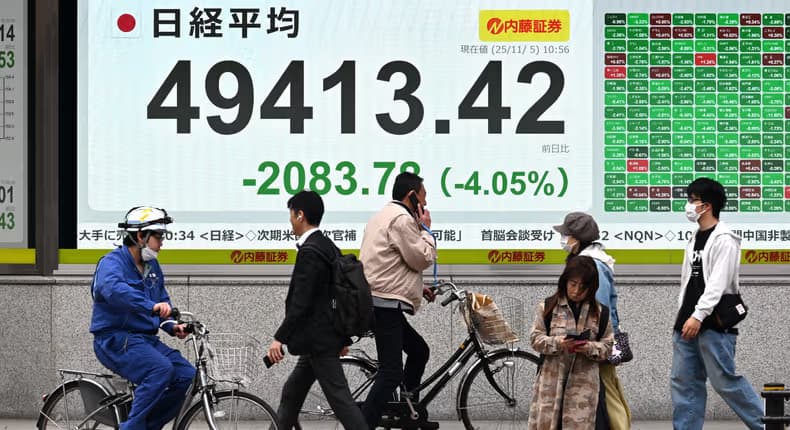
I’ve been watching the markets this week, and honestly, it’s starting to feel like the AI party’s taking a breather. The same stocks that investors couldn’t get enough of a few months ago are now the ones getting sold off—hard.
Across Asia, the numbers tell the story.
In Japan, the Nikkei 225 dropped as much as 4.7%, with Advantest Corp—a major chip-testing company—falling 11% in a single session. Over in South Korea, the KOSPI lost around 6.2%, dragged down by Samsung Electronics and SK Hynix, which sank 8.2% and 9.5% respectively. Meanwhile, Taiwan Semiconductor Manufacturing Co. (TSMC), one of the world’s most important chipmakers, shed nearly 3%, and Hong Kong’s tech-heavy Hang Seng Tech Index slid 2.9%.
These aren’t small dips. These are the kinds of moves that make investors stop and ask: Has the AI rally gone too far, too fast?
The AI trade is cooling — not collapsing
For much of the past 18 months, artificial intelligence has been the story driving everything—from chips to data centers to cloud stocks. It’s been easy to believe the narrative: that AI will transform industries, redefine productivity, and print profits.
But here’s what’s changing. The optimism is still there, but reality is starting to bite. Analysts are pointing out that valuations have stretched far beyond actual earnings growth. Many AI-related firms were priced for perfection—meaning any slowdown, any hiccup, or even a neutral headline could trigger a correction.
Pepperstone’s Chris Weston summed up the sentiment perfectly, calling it “a gloomy and damp portrayal of risk.” Investors aren’t dumping everything—they’re just rebalancing, taking profits after a monster run-up.
Then came Michael Burry
You know things are shifting when Michael Burry (yes, The Big Short guy) starts making moves. His recent disclosure of short positions against Nvidia and Palantir was enough to send ripples through the entire AI complex.
It’s not that Burry’s bets are guaranteed to pay off, but he has a way of shaking investor confidence. And right now, confidence in AI stocks is fragile. Following his filings, Palantir dropped about 8% despite posting better-than-expected earnings, while Nvidia slipped nearly 4%.
Those moves triggered a domino effect across the region. When the biggest names in the space start wobbling, smaller chip and AI suppliers tend to fall even harder.
The conversation is shifting fast
On X (formerly Twitter), investor chatter has gone from “How big can AI get?” to “How sustainable is this growth?” Some are calling this the first real test of the AI cycle.
A few investors argue this correction is long overdue—that it’s “a healthy pause” before the next leg up. Others are more skeptical, saying the market’s been drunk on future earnings that might take years (if not decades) to materialize.
There’s also talk around the “catalyst gap”. Until Nvidia’s earnings on November 19, analysts say the market lacks any fresh reason to buy. With no near-term catalysts, traders are happy sitting on the sidelines or cashing in profits.
As one note from Bloomberg Intelligence put it: “Investors are rethinking what growth really looks like in AI. The euphoria is fading, but belief in long-term adoption remains.”
What smart investors are doing now
If you’re managing a portfolio—or even just tracking your favorite AI and semiconductor plays—this is a moment to zoom out.
Corrections like this are uncomfortable, but they’re also revealing. They separate companies building real value from those just riding the narrative.
Right now, I’m watching three types of companies closely:
- AI infrastructure enablers – Think chip manufacturers, cooling systems, and data center energy players. These are the backbone of the AI economy, and demand for their products isn’t disappearing anytime soon.
- Software firms with recurring AI revenue – Not every company selling “AI-powered” solutions will survive, but those with measurable ROI and customer retention will.
- Cash-rich giants – Firms like TSMC, Samsung, and Nvidia still dominate, and pullbacks often create entry points for long-term positions.
For me, this isn’t the time to panic—it’s the time to reprice risk.
The bigger picture
Every major innovation cycle goes through this phase. The dot-com boom, the crypto surge, and now AI—they all start with wild optimism, then reality checks in.
The AI boom isn’t ending; it’s maturing. We’re moving from hype to proof, from narratives to execution. The market is saying: “Show me the earnings. Show me the adoption. Show me the moat.”
And that’s a good thing. Because when the dust settles, the companies that survive this correction will likely be the ones defining the next decade.
My take
If you’re long on tech or AI, stay patient. Trim where valuations are unrealistic, but don’t abandon the thesis. The AI transformation is too foundational to vanish with one correction.
But it’s also time to be smarter, not louder. Forget the buzzwords—focus on cash flow, customer adoption, and pricing power. That’s where the next wave of returns will come from.
So yes, tech and chip stocks are tumbling. But underneath the volatility, a new phase is beginning—one where the winners aren’t the loudest storytellers, but the quiet executors.